Critics argue that much more could have been done and that the government was slow to react to many events.

Given the many policy areas where the Centre and the states have not been seeing eye to eye in the last few years, it is time the Modi government convenes a meeting of the Inter-State Council, recommends A K Bhattacharya.
While players in the financial ecosystem are opening up to the idea of receivables funding for the sector, this market needs a regulator, which a Parliament panel feels only RBI can provide.
Almost 30% or a third of the agriculture ministry's budget, is spent on premium for the PMFBY every year

Back of the envelope calculations put government expense on each of the new schemes promised by the DMK and the AIADMK at tens of thousands of crores. But then, neither party has said how they are going to also address the mounting debt burden either, says N Sathiya Moorthy.
Amit Shah's net worth grew 32 per cent to Rs 37.91 crore, mainly due to 80 per cent appreciation in the market value of his securities.

Prime Minister Narendra Modi on Monday slammed those calling agitating Sikh farmers names, saying it won't do the country any good as he went on to appeal to the protesting farmers to withdraw their over two-month-long stir and give the new agriculture reform laws a chance.

The government will amend the six-and-a-half-decade old Essential Commodities Act to deregulate food items, including cereals, edible oil, oilseeds, pulses, onion and potato, Finance Minister Nirmala Sitharaman said on Friday. The amendment, besides deregulating production and sale of food products, will provide for no stock limit to be imposed on any produce.

The BJP campaign highlighted Yogi's persona as a tough-as-nails leader and an incorruptible man with no nest to feather; Modi's charisma which was turned on full blast in the penultimate phases; Amit Shah's ground work; a well-oiled party organisation, and the RSS's back-up.
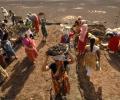
Sources said the rural development ministry has sought an additional Rs 20,000 crore for MGNREGA for 2019-20 over and above the budgeted Rs 60,000 crore for 2019-20. Though, all of the PM-KISAN savings may not be transferred to fund MNGREGA's extra needs, sources said a part of this could be transferred.
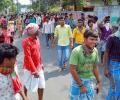
As the world awaits the end of the global pandemic, rural Bengal might be witnessing a recession unfolding in bits and pieces. With factories and tea gardens closing down, agricultural income falling and storm Aila ravaging a large part of deltaic West Bengal in 2010, migration gradually became a norm.

While India's GDP growth slowed to five-year low of 5.8% in Q4, China grew at 6.4%.
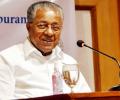
The LDF government -- which has negotiated a series of crises in the form of natural disasters to the Covid pandemic -- cannot turn a blind eye to the accumulated debt of the state that now exceeds Rs 3 trillion and the need for more jobs, investment and industry.

Agriculture and processed food exports dropped to a five-year low of $24 billion in 2015-16.

Kejriwal's centralised way of governance might work in Delhi, but Punjab will call for delegation, observes Sanjeev Nayyar.

Of these 8.5 million additional people employed in September, 6.5 million were in rural India, reveals Mahesh Vyas.
Aiming to push India into the list of the top 10 agri export nations, the policy has been backed by the Prime Minister's Office

DroughtThe Centre is expected to discuss issues related to drought management and also review the progress of major central schemes like soil health cards, irrigation programmes

The country's economy will start witnessing a growth of 6.5 to 7 per cent from fiscal 2023 onwards, helped by various reforms undertaken by the government so far and also as COVID-19 vaccination drive progresses, Chief Economic Advisor Krishnamurthy Subramanian said. He said the second wave of COVID-19 is unlikely to have a very significant on the economy. The country's economy contracted by 7.3 per cent in fiscal 2020-21. "Together with the reforms and focus on vaccination, I expect growth to start hitting close 6.5 to 7 per cent from FY23 onwards and accelerate from there on," Subramanian said at a virtual event organised by Dun & Bradstreet.
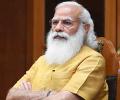
Prime Minister Narendra Modi on Friday held deliberations with Home Minister Amit Shah and BJP president J P Nadda amid speculation about a reshuffle in the Union cabinet, an exercise Modi has not undertaken since forming the government for a second time in May 2019.

The exercise, Agriculture Minister Radha Mohan Singh said, will help ease any possible impact of sub-par rainfall on farmers.

Finance Minister Nirmala Sitharaman on Monday presented the Budget for 2021-22 in the Lok Sabha that is expected to provide relief to the pandemic-hit common man as well as focus more on driving economic recovery through higher spending on healthcare, infrastructure and defence amid rising tensions with neighbours, As India emerges from the COVID-19 crisis, the ninth Budget under the Modi government, including an interim one, is widely expected to focus on boosting spending on job creation and rural development, generous allocations for development schemes, putting more money in the hands of the average taxpayer and easing rules to attract foreign investments.
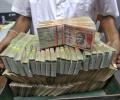
The government announced several incentives in the five-year Foreign Trade Policy.

The Reserve Bank on Friday retained the GDP forecast for the current financial year at 9.5 per cent and flagged global semiconductor shortages, elevated commodity prices and potential global financial market volatility as downside risks to economic growth. In his address after the three-day meeting of the rate-setting panel, RBI Governor Shaktikanta Das said recovery in aggregate demand gathered pace in August-September, and it is reflected in high-frequency indicators, like railway freight traffic; port cargo; cement production; electricity demand; e-way bills; GST and toll collections. "The ebbing of infections, together with improving consumer confidence, has been supporting private consumption," he said, and added the pent-up demand and the festival season should give further fillip to urban demand in the second half of the financial year.

They said that massive public investment in infrastructure, social sectors and agriculture would generate employment and the Union Budget should give it a priority and allocate necessary funds for this.

Past experience shows loan waivers benefited only 30% of India's farmers; here again, the richer cultivator skimmed the cream, leaving very little for his poorer brethren.

Faulting previous governments for not taking adequate measures to economically empower women in the country, Prime Minister Narendra Modi on Thursday said his government was constantly creating an environment in which women self-help groups can connect villages with prosperity as he released Rs 1,625 crore as capitalisation support fund to over four lakh such groups. In a virtual interaction with the women self-help groups (SHGs) under the "Aatmanirbhar Narishakti se Samvad" (dialogue with self-reliant women) initiative, Modi said in a changing India, opportunities are increasing for women to move forward. The movement of woman SHGs has intensified in the last 6-7 years with over 70 lakh of them working across the country, a figure over three times more than earlier, he said, adding over eight crore women are connected with these groups.

Union minister Prakash Javadekar accused the Congress of ignoring farmers' interests and keeping them poor to ensure cheap grain prices, and asserted that the Modi government empowered them by implementing the Swaminathan commission report to give them remunerative price through MSP.

More incentives will be given to agriculture sector for increasing agriculture production.
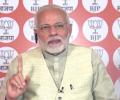
Modi said, "The Karnataka government was indifferent...it did not care about the benefits that a farmer can get from the Pradhan Mantri Fasal Bima Yojana."
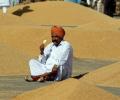
Rural budget set to increase; likely to enhance market linkages for agri commodities

With the world's worst outbreak of COVID pandemic stalling a nascent economic recovery, the government has begun assessing the impact of the second wave of infections on different sectors and may look at providing support at an appropriate time to segments requiring fiscal help. Some of the economic indicators, including the Goods and Services Tax (GST) collections, still provide confidence and incoming data will throw some more light on the state of the economy, sources said. Services sectors like hospitality, tourism and aviation which had just started recovering were hit hard by the second wave of COVID, the sources said, adding these segments might need some support on an urgent basis from the government.

'Our party cadre does not want her in the party.'

The administration of the union territory as directed by the Jammu and Kashmir high court to make public land given under the controversial Roshni land scheme, since scrapped by a court, came out with the list of beneficiaries.

A homemaker in every family would get a monthly assistance of Rs 1,000, the manifesto said.

Strict lockdown-like restrictions are already in place in the southern stateand the Pinarayi Vijayan government decided to clamp the complete shutdown in the wake of severe spike in the positive cases.

Stressing that economic growth will only move upwards, the Reserve Bank of India Governor Shaktikanta Das on Friday pegged the GDP growth rate for the next financial year at 10.5 per cent, though a tad lower than the government's projection of 11 per cent. The projection is in line with the estimates in the Union Budget 2021-22 presented in Parliament earlier this week. The Economic Survey, tabled by the government in Parliament recently, has projected that the economy will grow at 11 per cent, up from an estimated historic decline of 7.7 per cent in 2020-21, on account of the COVID-19 pandemic.

The Budget kept away from mood dampeners such as an increase in taxes (capital gain taxes) and even the much-feared introduction of Covid cess and wealth taxes, says Nimesh Kampani, chairman, JM Financial.

'We will resist it.' 'Farmers will not let that happen.'

Modi said the newly-sworn in government took four major decisions related to farmers' and traders welfare in the first meeting of the Union Cabinet.
 © 2026 Rediff.com - Investor Information - Advertise with us - Disclaimer - Privacy Policy - Sitemap - Feedback - About us - Terms of use - Grievances